
HUMAN SUSTAINABILITY: A Concept We Cannot Afford to Misunderstand
- February 27, 2026
- Posted by: Jelena Viskovic Vasic
- Category: Invisible Bridges
There are moments in professional life when you realize that you have been circling around an idea long before you consciously named it or found theoretical proofs for it, and that the term itself appears only after years of practical observation, intellectual discomfort, and quiet dissatisfaction with the language available to describe what you were already seeing.
When I began working more intensively on employer branding for my master’s thesis research, I was not attempting to introduce a new construct; I was trying to articulate a structural truth that had long been present in my practice: sustainability is not only about environmental footprint… it has to be (and is) also about the preservation of human capacity within the organization.
I was, quite simply, a pragmatic HR manager.
When I officially used the term human sustainability in my research, it was not a sudden intellectual invention. It was a recognition that brought conceptual coherence to years of practical observation – the final articulation of something that had been present in my work for years.
For more than two decades in HR, my concerns were rarely abstract. I was not searching for theoretical novelty. I was searching for stability inside systems. I wanted organizations that function beyond temporary enthusiasm and quarterly performance spikes. I wanted teams that remain psychologically intact under pressure. I wanted people who can deliver consistently without silently deteriorating. And perhaps most pragmatically, I wanted what every HR professional quietly desires: a stable pool of capable, motivated candidates who want to enter and remain, allowing transitions to occur without disruption: when one exits, another can enter without weakening the structure.
Because without that internal stability, everything else is decoration.
An organization can have strategic clarity, market visibility, and financial growth. It can celebrate longevity and display impressive milestones. But if the human system inside it is chronically exhausted, cognitively overloaded, emotionally detached, or constantly scanning for exit opportunities, then the stability is fragile, even if it looks solid from the outside.
I did not initially call this sustainability, retention, engagement, succession, talent management or organizational health. Yet beneath all these operational terms, there was a deeper structural question forming: what enables an organization to regenerate its human capacity instead of gradually consuming it?
Beyond Profit and External Sustainability – Look inside
As my research evolved, sustainability became impossible to ignore. It appeared in corporate strategy, in ESG frameworks, in environmental responsibility standards, in discussions around Green HRM and corporate social sustainability. The literature was rich. Elkington’s triple bottom line had long positioned economic, environmental, and social dimensions as coexisting pillars of responsible business, fundamentally reshaping how organizations speak about value creation. Sustainable HRM scholars, particularly Ina Ehnert and others, expanded this conversation by arguing that long-term performance must include the preservation and development of human resources rather than their short-term exploitation. Jeffrey Pfeffer’s work further exposed how modern management practices often generate hidden human costs in the pursuit of financial efficiency.
And yet, despite the depth of that literature, I sensed a persistent imbalance.
Sustainability is widely discussed, but often from an external perspective. In Bosnia and Herzegovina, as in many transitional contexts, corporate sustainability and employer branding are frequently framed through visible external commitments – community initiatives, social projects, environmental campaigns, alignment with international standards, reputational positioning toward the market. These dimensions matter, and they signal awareness.
But the internal dimension is rarely examined with equal seriousness.
Rarely do we ask whether the human system inside the organization is itself sustainable – not socially responsible in appearance, not compliant on paper, not attractive in branding campaigns, but structurally sustainable in its daily functioning.
Can the organization preserve the psychological, cognitive, emotional, and relational resources of its people in a way that allows long-term contribution without chronic depletion? Can it regenerate energy rather than merely redistribute it? Can it support growth without normalizing exhaustion?
These questions slowly reshaped my understanding of both employer branding and corporate sustainability.
The Internal Dimension of Corporate Social Sustainability
In my thesis, human sustainability did not emerge as a fashionable expression. It emerged as a conceptual necessity.
If employer branding is to be more than communication, it must reflect lived experience. And lived experience is determined by how work is designed, how leadership regulates pressure, how realistic performance expectations are, how psychological safety is maintained, and whether individuals can retain dignity and agency within the system.
Human sustainability, as I conceptualized it, refers to the organization’s capacity to preserve, develop, and regenerate the psychological, cognitive, emotional, and relational resources of its people, ensuring that long-term contribution does not come at the cost of invisible erosion. It represents the internal core of corporate social sustainability – the part that is rarely highlighted but fundamentally decisive.
This is not an ethical slogan. It is system intelligence.
Because, when cognitive overload becomes normalized, decision quality inevitably declines. When chronic stress narrows attention, creativity and strategic thinking diminish. When fear shapes communication, trust deteriorates, and once trust erodes, employer branding becomes narrative rather than reality.
Organizations often declare that people are their greatest asset, yet strategy frequently treats people as infinitely renewable resources – stretchable, replaceable, expandable. Capital can be reinvested. Technology can be upgraded. Processes can be redesigned. Human nervous systems cannot be endlessly intensified without cost.
Energy depletes. Meaning fractures. Engagement becomes performative. Loyalty becomes transactional.
Longevity does not equal sustainability. A company’s existence since the 1980s or the celebration of a 15th anniversary does not confirm that its human core has remained regenerative; it only confirms that it has survived.
The Future Layer: AI, Metacognition, and Cognitive Sovereignty
Recently, I encountered an article discussing the relationship between artificial intelligence and metacognition – the human capacity to reflect on and regulate one’s own thinking processes. The connection struck me immediately because it illuminated the next layer of this conversation.
Organizations are rapidly integrating AI systems to optimize performance, automate decision-making, and increase efficiency. Cognitive tasks are being redistributed. Processes are accelerating. Expectations of adaptability are intensifying. On the surface, technology appears to reduce human burden. In reality, it often transforms it.
If we amplify technological intelligence without simultaneously strengthening human metacognitive capacity – the ability to pause, evaluate, regulate attention, and consciously manage cognitive load – we risk accelerating depletion rather than preventing it, potentially narrowing cognitive depth and weakening sustained memory formation.
Human sustainability in the coming decade will not only concern workload distribution or engagement scores. It will concern cognitive sovereignty: the ability of individuals to remain mentally autonomous, reflective, and psychologically regulated within increasingly automated environments.
Without that internal regulation, AI does not replace burnout; it amplifies systemic pressure.
The Term I Was Already Living
Looking back, I realize that I was not merely researching employer branding. I was searching for an organizing principle that explains why some organizations stabilize and regenerate talent while others constantly recruit yet rarely retain.
The answer was not marketing. It was not compensation alone. It was not external CSR visibility. It was whether the organization had the structural intelligence to sustain the humans within it.
Human sustainability is not anti-profit. It is long-term profit logic. Revenue, innovation, reputation, and competitiveness are not abstract forces; they are outcomes of preserved cognitive clarity, emotional stability, and relational trust.
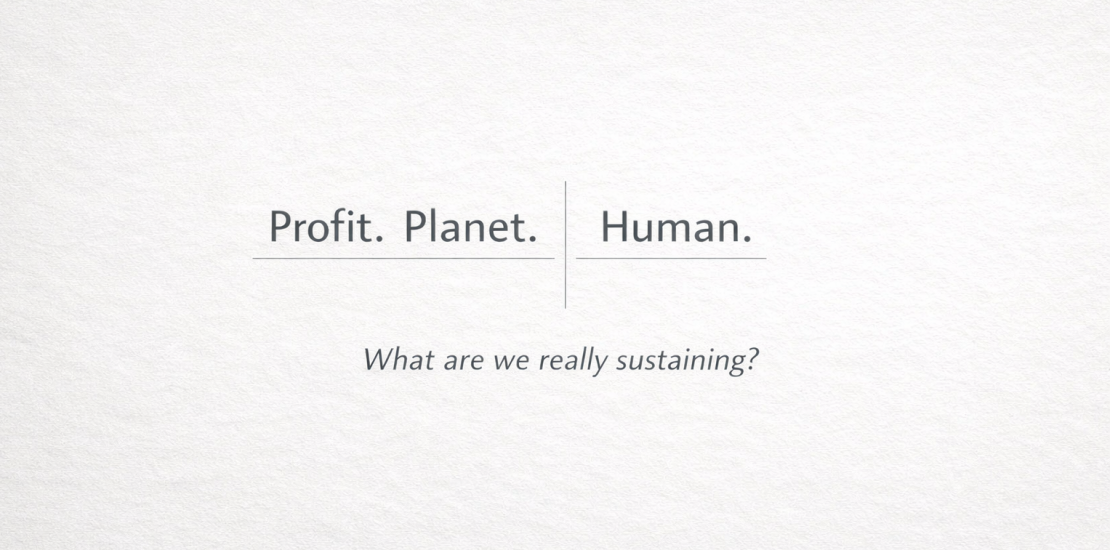
So the question remains, and it is not rhetorical: When we speak about sustainable organizations, what exactly are we sustaining? Financial indicators? Brand image? Or the human capacity that makes both possible?
This text was originally published on LinkedIn as part of the Invisible Bridges newsletter and is republished here as part of my professional blog archive.